Compensatory Signaling Changes with Under-Responsive Postsynaptic D2/D4 Receptors in ADHD
- Esther Adams-Aharony

- Nov 8, 2025
- 4 min read
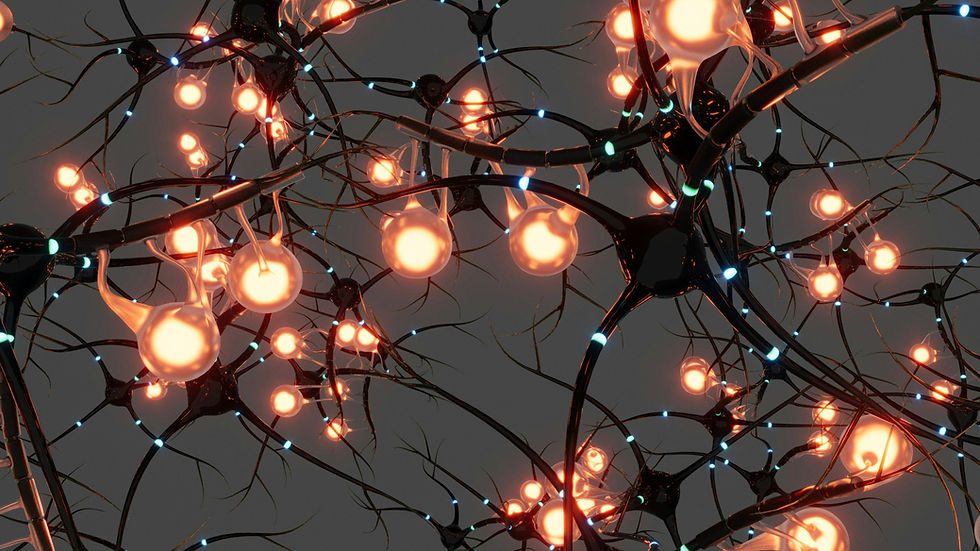
Dopamine signaling doesn’t exist in isolation — it’s deeply intertwined with other receptor systems and intracellular pathways. In ADHD, when postsynaptic dopamine D2 and D4 receptors are under-responsive, the brain doesn’t simply shut down these circuits. Instead, it attempts to adapt through a cascade of compensatory changes that influence everything from receptor availability to gene expression. These adaptations can have both short- and long-term consequences, particularly when they occur during sensitive periods of brain development.
One important area of compensation involves the NMDA receptor, a key player in excitatory neurotransmission. The D4.7 receptor variant, which is linked to ADHD, has been shown to excessively suppress NMDA receptor function in the prefrontal cortex. This over-suppression leads to lower surface expression of NMDA receptors, reduced synaptic signaling, and weakened interaction with scaffolding proteins like PSD-95, all of which impair proper synaptic function (Qin et al., 2016). These cellular changes are directly associated with behavioral symptoms resembling ADHD and may be partially reversible by pharmacologically stimulating NMDA receptors.
Developmental timing makes a big difference in how these changes manifest and persist. When NMDA receptors are blocked early in life using compounds like MK-801, animals show lasting deficits in attention and memory, behaviors that mirror ADHD. These disruptions are accompanied by altered survival pathways in the brain, such as increased levels of cleaved caspase-3, a marker of programmed cell death, and disrupted activation of Akt, a protein involved in neuron survival and growth (Kawade et al., 2019). Such findings suggest that early disruptions in NMDA signaling can lead to long-lasting changes in prefrontal and hippocampal circuits, reinforcing the idea that childhood is a particularly vulnerable window for dopamine-glutamate imbalances.
Alongside NMDA signaling, intracellular pathways involving cAMP and ERK also undergo adjustments when dopamine receptors are under-active. When D2-like receptors are blocked or under-functioning, levels of cAMP rise in striatal neurons. This in turn activates protein kinase A (PKA), which can influence gene transcription through histone modifications like H3 phospho-acetylation — effectively altering how tightly DNA is wound and which genes are turned on or off (Li et al., 2004). Interestingly, this form of chromatin remodeling isn’t just triggered by dopamine alone; it also depends on NMDA receptor activity, suggesting a convergence of dopaminergic and glutamatergic input at the level of gene regulation.
The convergence of D2/D4 receptor function and NMDA receptor signaling on cAMP and ERK pathways points to a broader system of regulation that tries to maintain neuronal balance. However, this balance is delicate and not always sustainable. In cases where dopamine receptor signaling is chronically reduced — either through genetic variants or developmental insults — these compensatory pathways may end up amplifying dysfunction instead of resolving it. For example, increased caspase-3 activity and decreased survival signals may weaken circuits over time, making the brain less adaptable to future demands (Kawade et al., 2019).
Age appears to be a critical factor in how these compensatory processes unfold. The earlier in life that NMDA receptor function is disrupted, the more severe and persistent the changes tend to be. In contrast, similar disruptions in adulthood do not appear to trigger the same long-lasting structural and behavioral consequences. While direct comparisons of cAMP or ERK-related compensation between children and adults are limited, the data suggest that developmental timing is a major variable in determining the extent of neuronal and behavioral impact (Kawade et al., 2019). This may help explain why ADHD symptoms often begin in childhood and why early interventions tend to be more effective than those introduced later.
What all of this research points to is a dynamic, plastic brain that is constantly trying to compensate when a major signaling system — like dopamine — isn’t working optimally. When postsynaptic D2 and D4 receptors are under-responsive, the brain doesn’t passively accept the deficit. Instead, it recruits backup systems, adjusts receptor expression, remodels chromatin, and shifts survival pathways in an attempt to recalibrate. Some of these adaptations may be helpful in the short term, but others could contribute to the chronicity or complexity of ADHD symptoms over time.
These findings also help explain why treatment responses in ADHD can be so variable. If two individuals have similar receptor deficits but different histories of early-life disruption, the downstream adaptations in their brain circuits may differ significantly. This could influence how well they respond to dopamine-targeting medications or whether they benefit from glutamatergic interventions. Understanding these compensatory mechanisms opens up new possibilities for more tailored treatment strategies that consider developmental timing and circuit-level adaptations.
The big takeaway here is that ADHD involves more than just a lack of dopamine. It reflects a broader set of neuroadaptive responses to disrupted dopamine receptor signaling, especially in the prefrontal cortex and striatum. These adaptations touch multiple systems — including NMDA receptor function, cAMP signaling, gene transcription, and neuronal survival — and they evolve differently depending on when in development they begin. In other words, the biology of ADHD is not static. It’s the result of ongoing changes in the brain’s attempt to adapt to imbalanced signaling.
References
Kawade, H., Borkar, C., Shambharkar, A., Singh, O., Singru, P., Subhedar, N., & Kokare, D. (2019). Intracellular mechanisms and behavioral changes in mouse model of attention deficit hyperactivity disorder: Importance of age-specific NMDA receptor blockade. Pharmacology Biochemistry and Behavior, 188, 172830. https://doi.org/10.1016/j.pbb.2019.172830
Li, J., Guo, Y., Schroeder, F., Youngs, R., Schmidt, T., Ferris, C., Konradi, C., & Akbarian, S. (2004). Dopamine D2‐like antagonists induce chromatin remodeling in striatal neurons through cyclic AMP‐protein kinase A and NMDA receptor signaling. Journal of Neurochemistry, 90(5), 1117–1131. https://doi.org/10.1111/j.1471-4159.2004.02569.x
Qin, L., Liu, W., Wei, J., Zhong, P., Cho, K., & Yan, Z. (2016). The ADHD-linked human dopamine D4 receptor variant D4.7 induces over-suppression of NMDA receptor function in prefrontal cortex. Neurobiology of Disease, 95, 194–203. https://doi.org/10.1016/j.nbd.2016.07.024


Comments