The Double Bind of Partnership: When Caring for Your Competitor Becomes Competition Itself
- Esther Adams-Aharony

- Oct 25, 2025
- 7 min read
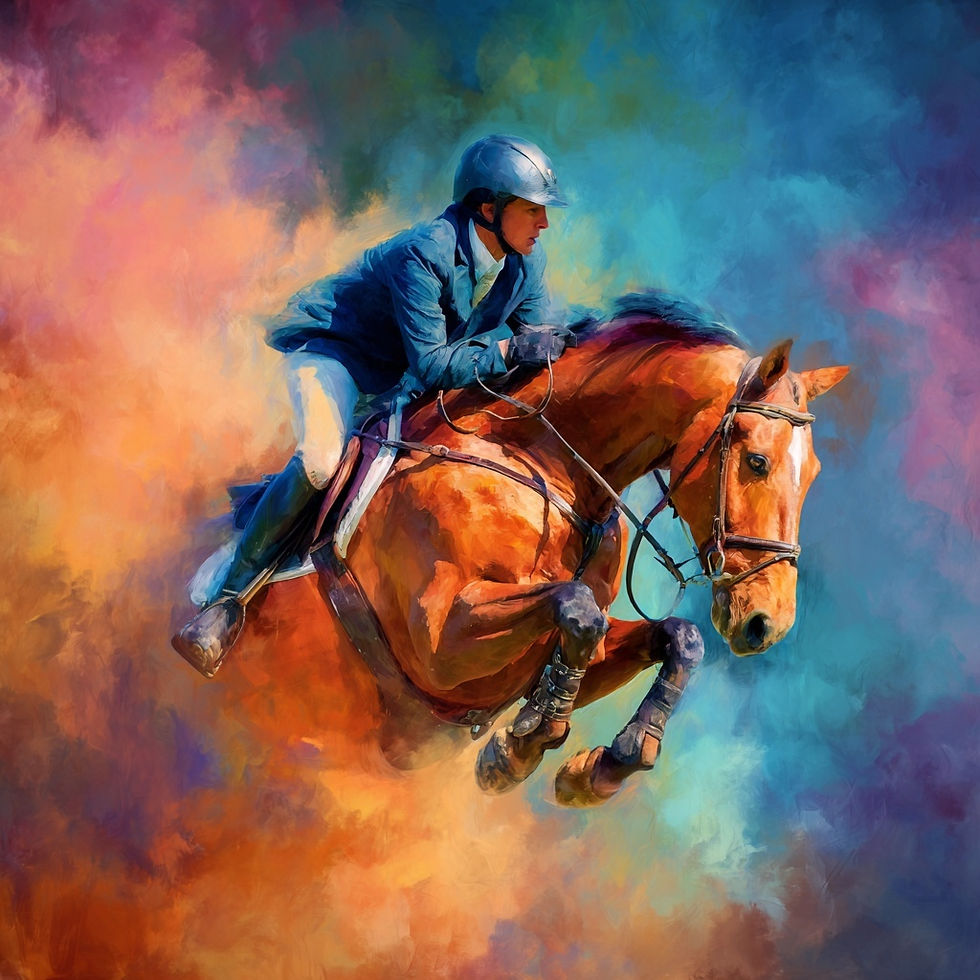
There's something unique about equestrian sport that confounds easy categorization—the athlete's primary relationship isn't with teammates or opponents but with another living being whose welfare is simultaneously their responsibility and their pathway to success. Equestrians occupy a psychological space that other athletes don't: they're caretakers and competitors, partners and performers, responsible for a sentient being whose needs sometimes conflict with the demands of winning. How they navigate this dual identity reveals something interesting about what happens when care and competition collide.
The research on equestrian athletes shows that many develop what gets called a "horse-centric identity"—a sense of self fundamentally rooted in their relationship with horses (Sanchez, 2024; Hogg & Hodgins, 2021). This isn't just affection or professional obligation. It's deeper, more constitutive of identity. These athletes see themselves as "horse people" first, competitors second, and that ordering matters psychologically. The caretaker role isn't something they perform alongside competition; it's woven into how they understand what competition means and how success should be pursued (Sanchez, 2024; Hogg & Hodgins, 2021).
What's striking is that this identity seems to function as both foundation and complication for competitive performance. The deep care, love, and responsibility athletes feel for their horses fosters resilience, patience, and adaptability—qualities essential for managing the emotional and physical risks inherent in partnering with a thousand-pound animal with its own will and moods (Sanchez, 2024; Hogg & Hodgins, 2021). The bond itself becomes a resource for performance. Athletes who see their relationship with their horse as central to well-being report that connection enhances rather than detracts from competitive outcomes. Care and competition aren't opposing forces to be balanced but mutually reinforcing aspects of a single integrated practice.
At least, that's the ideal. The reality gets messier under pressure.
High-stakes competition introduces tensions that test whether the integration of care and performance can hold. Elite riders report that strong emotional bonds with horses sometimes make purely performance-driven decisions harder, particularly when external pressures intensify (Hogg & Hodgins, 2021; Furtado et al., 2021). Owners who've invested significant money expect results. Sponsors want visibility and wins. Team officials prioritize medals over individual horse welfare concerns. And suddenly the athlete is caught between what they believe their horse needs and what powerful others are demanding they deliver.
The ethical dimension here isn't abstract—it's immediate and embodied. Should you compete when your horse seems slightly off, not injured exactly but not quite right either? Do you push for one more round when you've already qualified, knowing it adds risk but might improve your final placement? How do you navigate disagreements with owners who want different training approaches or competition schedules than you think serve the horse's best interests? These aren't hypothetical dilemmas. They're the daily negotiations of trying to maintain integrated identity under conditions that reward splitting it apart (Hogg & Hodgins, 2021; Furtado et al., 2021).
Some athletes cope by creating emotional distance, compartmentalizing the caretaker identity to protect against the guilt that comes from prioritizing performance over welfare. If you don't let yourself feel too much, the reasoning goes, the decisions become easier—more professional, less conflicted. But that distancing carries its own costs, both psychologically and in terms of the partnership quality that equestrian success often requires. Other athletes resist this split, striving to align ethical care with performance outcomes and advocating for a sporting culture where animal welfare and competitive success are genuinely inseparable rather than perpetually in tension (Hogg & Hodgins, 2021; Furtado et al., 2021).
The cultural context complicates everything further. Equestrian sport exists within broader social expectations about what athletes should be and how they should present themselves. The research identifies pressure to perform what gets called the "super equestrian" identity—professional, high-performing, visually ideal, seemingly effortless in managing both athletic and caretaking demands (Broms et al., 2020; Dashper & St John, 2016). Social media amplifies this pressure, creating spaces where equestrians curate images of perfect partnerships, flawless performances, immaculate stable environments. The messiness of actual care—the early mornings mucking stalls, the veterinary crises, the emotional labor of managing a horse's anxiety or your own—gets edited out in favor of aesthetically pleasing glimpses of harmonious partnership.
This creates what amounts to adaptive identity work, an ongoing negotiation between authentic experience and social expectations (Broms et al., 2020; Dashper & St John, 2016). Equestrians find themselves managing impressions, deciding what aspects of their dual identity to emphasize in different contexts. With sponsors and competition organizers, they might foreground competitive achievements and professional demeanor. Within stable communities, they might emphasize caretaking knowledge and horse welfare commitments. On social media, they navigate between presenting aspirational images and sharing authentic struggles, aware that both have audiences but different ones.
What's interesting is that many equestrians value authenticity and actively resist the pressure toward perfect presentation. They want to share the realities of both care and competition—the difficult decisions, the setbacks, the ethical tensions—not just the polished outcomes (Broms et al., 2020; Dashper & St John, 2016). There's recognition that the "super equestrian" image is not just unattainable but potentially harmful, setting standards that make genuine integration of caretaker and competitor identities harder rather than easier. Authenticity becomes its own form of resistance against cultural pressures that would split the dual identity into compartmentalized performance.
Community norms and collective values play a significant role in how successfully equestrians maintain their integrated identity. Equestrian sport has what amounts to a unique ethos, one that—at least in principle—values both tradition and partnership, respecting the horse as participant rather than mere equipment (Sanchez, 2024; Dashper & St John, 2016). This ethos provides psychological scaffolding for athletes trying to reconcile care and competition. When the community reinforces that good horsemanship and competitive success are complementary rather than contradictory, it becomes easier for individual athletes to resist pressures that would prioritize performance over welfare.
Resilience gets cultivated through this integrated identity in ways that might seem counterintuitive. You'd think the dual demands—being responsible for another being's wellbeing while pursuing competitive goals—would increase stress and vulnerability. Sometimes it does. But the research suggests that for many equestrians, the integration itself becomes a source of psychological strength (Sanchez, 2024; Dashper & St John, 2016). The relationship with the horse, the sense of shared purpose, the ethical framework that prioritizes partnership—these provide resources for navigating setbacks and high-pressure situations that athletes in individual human-only sports might lack.
There's something about caring for another being, about making decisions that consider more than your own achievement, that seems to foster a kind of grounded perspective. When competition becomes difficult, when performance plateaus or injury sidelines you, the horse is still there needing care. The identity doesn't entirely collapse because it was never solely about competitive outcomes. The caretaker role persists independent of athletic success, providing continuity and purpose that pure competitor identities can't access.
This isn't to romanticize equestrian sport or suggest it's solved problems other sports haven't. The tensions are real, the ethical compromises happen, and not every athlete successfully integrates their dual identity. Some prioritize competition at their horse's expense. Some burn out trying to meet impossible standards of perfect caretaking and perfect performance simultaneously. The power dynamics—owners, sponsors, officials—create pressures that individual athletes can't always resist, no matter how strong their horse-centric identity.
But what the research reveals is that equestrians who do successfully reconcile their caretaker and competitor identities aren't doing it through balance or compromise—those frameworks suggest the two roles are fundamentally separate, requiring careful equilibrium. Instead, they're integrating horse welfare into their very definition of what success means, engaging in ongoing identity work to resist cultural pressures toward splitting, and drawing on community values that reinforce the legitimacy of their dual commitment (Sanchez, 2024; Hogg & Hodgins, 2021; Broms et al., 2020; Dashper & St John, 2016; Furtado et al., 2021).
The integration isn't static or simple. It requires constant navigation, ethical decision-making under pressure, and willingness to prioritize relationship over immediate competitive advantage when those come into conflict. It means sometimes making decisions that cost placements or prize money because the alternative would violate the caretaker identity that makes competition meaningful in the first place. And it requires communities and systems that support rather than undermine athletes' efforts to maintain that integration.
Perhaps what's most interesting about equestrian athletes' dual identity is what it suggests about athletic identity more broadly. We tend to assume that single-minded focus produces the best competitive outcomes, that any competing identity or commitment dilutes athletic performance. But equestrians demonstrate that integrating care—responsibility for another being's welfare—with competition can enhance rather than diminish both. The partnership becomes the point, not an obstacle to overcome. And success gets redefined as something that must include, not just accommodate, the wellbeing of all participants.
Whether other sports could learn from this model is an open question. But it's worth considering what we might gain by thinking of athletes not just as competitors but as people whose identities necessarily encompass multiple, sometimes tension-filled roles and that navigating those tensions skillfully might be a form of excellence all its own.
References
Broms, L., Hedenborg, S., & Radmann, A. (2020). Super equestrians – the construction of identity/ies and impression management among young equestrians in upper secondary school settings on social media. Sport, Education and Society, 27(4), 462–474. https://doi.org/10.1080/13573322.2020.1859472
Dashper, K., & St John, M. (2016). Clothes make the rider? Equestrian competition dress and sporting identity. Annals of Leisure Research, 19(2), 235–250. https://doi.org/10.1080/11745398.2015.1095103
Furtado, T., Preshaw, L., Hockenhull, J., Wathan, J., Douglas, J., Horseman, S., Smith, R., Pollard, D., Pinchbeck, G., Rogers, J., & Hall, C. (2021). How happy are equine athletes? Stakeholder perceptions of equine welfare issues associated with equestrian sport. Animals, 11(11), Article 3228. https://doi.org/10.3390/ani11113228
Hogg, R., & Hodgins, G. (2021). Symbiosis or sporting tool? Competition and the horse-rider relationship in elite equestrian sports. Animals, 11(5), Article 1352. https://doi.org/10.3390/ani11051352
Sanchez, L. C. (2024). "Lace up your boots and do something:" A symbolic-interactionist analysis of girls and young women equestrian athletes' resilience. Symbolic Interaction, 47(4), 702–728. https://doi.org/10.1002/symb.702


Comments